
Code Red
What I couldn’t teach my daughter about the sun

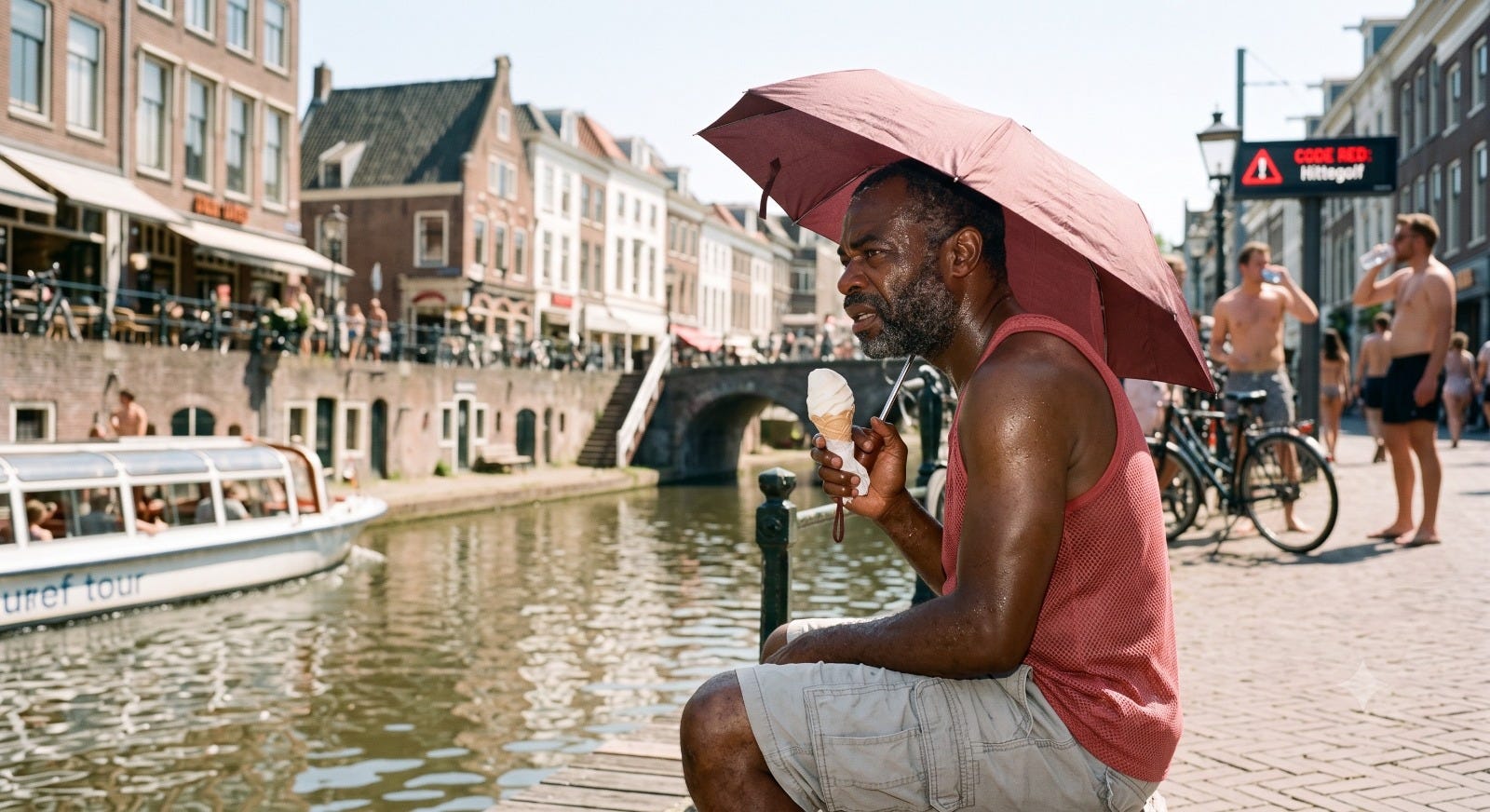
You would think, I know a lot about heat. I am a grown man, born and raised under the equator. I have been sun soaked and baked for decades. My skin tone is glistening melanin. I was born in Kisumu, during one of the hottest months where intense daytime temperatures beat down, and make the air thick with dust. This was my introduction to the world.
I have holidayed in Lodwar where it is blinding to look at the sky. The heat interrogates your marrow, cooking your thoughts until you start to ponder over existential questions. I have lived in Lamu, where I abandoned underwear and resigned to the aerated simplicity of a shuka and a vest. All through this, never thought to apply sun screen because common sense dictates that you stay under a green canopy until the heat passes. Heat was just something to be managed and it had its rhythms.
You would think, it holds that I have real lived experience of heat. After all, I am a genuine survivor of a near-death, heat-related event. The memory is still fresh though it happened decades ago. I had registered to run the full Lewa Safari marathon because, what is a marathon other than a very, very long jog. I had done all the pragmatic things. Jogged 5kms daily for about two weeks, abstained from sex, then the night before did carbo loading, just to make sure I had extra juice for the trail. On top of all this, I had acquired a military-issue tactical Camelbak hydration backpack with a delivery tube and bite valve, a flexible plastic hose that runs over the runner’s shoulder and clips to the front of the vest for effortless hydration on the go.
You would think that sounds well prepared. I thought it odd that the race organisers wanted us at the starting line by 6.45am and when they mentioned it was because of the heat, I didn’t panic. The first 5k was great by any measure, steady cadence, upright posture. I was way ahead of the herd and had the elites in my line of sight for at least a kilometre. Then the engine started overheating. The hydration therapy did not produce the anticipated results. The camelbak soon felt like an actual camel on my back. Somewhere around the 7k mark, the gasket blew and I was reportedly spotted on the side of the trail chugging the water. The rational thought process had slipped away at this point and I only had one thought in my mind, I have to survive. So I carried on as the entire herd ran past me, even the walkers came and went, each with a similar look of concern and the recurring query,
“Are you okay mate!”
It was the ego that stopped me from laying on the ground and waiting for the rescue chopper, because after all the old ladies trotted past, I knew I wouldn’t survive the roasting that awaited me at the end of this race if I quit. I imagined in my head that I was maintaining an easy jog pace but witnesses described a big man slugging through the dust, perpendicular to the ground. I should point out the Lewa marathon circuit is a double loop of 21kms. Since God is good, all the time, I made it to the end of the first 21k and got into a fight when the race marshals insisted that was not the end of the 42k. It was the proverbial last kick of a dying horse that fortunately, missed its target, resulting in a rather undignified collapse. But I had made my case. I was not going back to hell.
You would think that must have been a turning point. Indeed, to some degree it was, I moved on to a relatively modest stint as a one-acre farmer in the blazing hot Siaya sun. I had learned to respect the sun and followed the lead of the veterans. That meant getting to the farm before sunrise, so that it would find you after the momentum was gained and out at its peak at 1pm. That was the rhythm. With those incredible weather credentials, I ventured North, with only one fear on my mind: winter.
My introduction to European weather as a child came through Santa Claus, who operated amidst the cold and darkness. I would learn that comfort indoors in winter was a privilege. Heating is costly and the natives here have learned to tolerate the cold. My first summers in Europe were cold and wet, I thought no wonder the Dutchies all abandon their country in the warmest months of the year. I remember it rained straight for two weeks in July and by the time autumn arrived I was punctuating every conversation with a weather forecast. The chill seemed to follow me everywhere, from the outdoors and into my bed. One Kenyan veteran aptly described it as, whether you like it or not, weather.
But I survived northern European winters and resisted the urge to return to paradise. The cold in the Netherlands has thrown everything at me but I am no longer fazed. I was one of the calmer residents when a snow storm and high winds came in February and triggered a code yellow warning. There was countrywide travel chaos and Schiphol international airport cancelled over 60 percent of its scheduled flights. It was a third-world level, open-air market ruckus. The government, faced with a criticism of unpreparedness for this weather event, said it would pass. Not worth changing infrastructure for a few days of heavy snow. We are not Norway.
You would think, what else is there to worry about after this. Summer must be a breeze, given my tropical pedigree. Just last month, the Netherlands issued a code red warning. There was a heat wave melting everything on its path through Europe and it was now the Netherlands’ time to fry.
The phone buzzed in the early morning with an emergency alert. Code red. I had never received a warning this formal about warm weather and by my estimate, it was just going to be the equivalent of a stifling hot day in Kisumu, in January. I checked the app with the trepidation of a man checking his bank balance the morning after a wild night. Thirty six degrees Celsius, the little sun icon was stretched across the day and it said it would feel like thirty eight.
By midday, I had checked it over ten times. I know this because my wife pointed it out as she asked me what my coping strategy was. Back home a grown man does not consult an app if he should go outside. He reads the sky and makes a decision. Here, I was refreshing my weather app like a party agent waiting for the final vote tally. Public transport was disrupted and I heard rumours of infrastructure malfunctioning.
At 2pm it hit thirty five, one degree short of the app’s own prophesy and when I went on social media, my feed was jammed with apocalyptic messages; stay indoors, avoid strenuous activity, hydrate and all sorts of cooling hacks from novices showing signs of early stage heat hallucination. Those bastards got to me. I sat down in panic.
I had watched the street do it for two days before I attempted it myself. Every house in the neighborhood had its curtains drawn by seven in the morning, and at first I couldn’t make sense of this native custom in a country known for its open windows and no curtain policy. I asked a local, an academic, about this strange custom thinking someone important had died and was this the Dutch version of flying the flag at half-mast. She explained. It is to keep the heat out. Whatever you do, do not let the sunlight in. The house will trap the heat. Open the windows at dusk when the outside temperatures are lower than the interior temperatures.
I felt like a fool. We had kept our windows open and kept wondering why the house was stuffed with thick, unmoving air, possessing rooms like an evil spirit. The house was warm enough to bake bread and I had recurring thoughts about buying a boat.
By the next morning I had become a full convert and militant in execution, like a bouncer deciding who gets past the rope. Curtains were drawn at seven, blinds down and the house kept in a state of daytime darkness more suited to a vampire, monitoring the app and waiting for the outside temperatures to drop low enough to allow cool air in. I caught myself, sometime in the afternoon, explaining this system to a Kenyan friend with the stuffy authority of a man who held a patent to this invention. My wife overheard me and asked why I hadn’t done this from day one and I told her some lessons are worth the sweat.
I had purchased two portable fans and they were frankly just a placebo gimmick for the kids. I made another call to the local, the academic, about the minimal use of air conditioning and ended up on the receiving end of a lecture on environmental responsibility and common sense. The summers are mild, it only lasts a few days, she said as I stared at the thirty six degree reading on my app.
After this call, I went to the local supermarket for ice, because my stock had run out. I was too late. What remained in the cold section was a single devastated shelf of ice cream. Outside the supermarket I found a queue of elderly people waiting patiently to buy ice cream cones. My eyes settled on this man, who had the rugged sturdiness of a World War Two veteran, slurping up his ice cream cone with glee on his face. I began to suspect that this love of ice cream was not really about the heat. It appeared to me as a license to indulge in a scoop of childhood joy, to return to a time when all you needed to endure the heat was a dip in the canal and an ice cream cone.
I needed to get back to the house before my own box melted but stopped to watch a group of giddy boys jumping into a canal that I have never seen anyone swim in, with no ceremony or negotiation with whatever lived down there. Where I come from you do not enter a water body on a whim. It is strongly advised to approach any water body with appropriate respect for whatever unnamed thing might be renting the bottom of it.
By the third night, I understood that the memory of heat I had been carrying was different. The European summer sun and the tropical sun are not the same creature. The heat here did not dial down after 4pm. The thermostat read thirty at midnight, the same number it had read at two in the afternoon, and my wife and I sat facing a single fan and not enjoying each other’s company as we hydrated with whatever cold sugary drink could deliver the placebo effect we needed to get through the night. Summer nights can be as brutal as the days and come with restlessness that makes a mosquito menace pale in comparison. At least with mosquitos you can duck under a net.
At the internationals barbeque in the park that weekend, trading survival stories, the whinging was dialed up. A Zimbabwean mate described his flat as a kiln, another raised theirs to a sauna and someone bragged about sleeping in a tent in their backyard. I offered my own thermostat reading and was met with nods of approval. Weather whinging was not really about the weather. It was a cultural integration test, and I had proven fluency.
I felt a strange sense of camaraderie on my way home. We had survived something together, even something as small as a ridiculously warm week. The neighbourhood streets were empty in the way they get after 10pm here. The sun was still up, this time pleasant but nobody was outside to enjoy it. What nobody at that barbeque mentioned was that this was, in fact, going to be the norm.
Something had shifted and it wasn’t for the better. For most of the year, this sun behaved like a torch held at arm’s length, all light but no heat, and then for two or three weeks, it drops the act and comes at you like it has a grudge to settle. Back home we had a name and shape for this kind of behaviour, El Nino, a weather event that misbehaves and is expected to. Here it came with the benign term, heatwave, while a more appropriate term would be Sahara is coming!
The thought lingered in my mind. A heatwave that recurs is not just freak weather anymore, it is a forecast of the world my daughter will grow up in. My daughter asked me, on the worst of the three nights, why I kept telling her to sit still and not kid around and I opened my mouth to repeat my imported tropical wisdom, and stopped before I uttered a word. She was looking at me the way she does when she suspects the answer was going to be vague but she waited anyway.
I had a whole inheritance of heat wisdom and none of it had a translation for children who are not bilingual in climate. How could I teach her about heat fluency and to move through the heat without carrying its assault on her skin when she had seen me succumb to panic and take refuge in ice cream? I ended up telling her to obey her parents, as the bible instructs, and to sit still in front of the fan, then bought her compliance with another rainbow ice lolly.
I now keep the freezer stocked, the way you’d keep a fire extinguisher, for an emergency. My daughter thinks this is just what her father does in summer, dispensing ice cream like a drug dealer. I haven’t confessed to her that I am waving a white flag. Some inheritances skip a generation. This heat, I suspect, is just getting started, and I’m still learning the language I’m meant to be teaching her.
You may now purchase my book Strength and Sorrow HERE and across major bookshops in Nairobi.
Strength and Sorrow by Oyunga Pala is now available for purchase on Amazon for the Kindle and Paperback HERE.