
Isolation Ward 5C
Waiting for the ordinary and the unremarkable

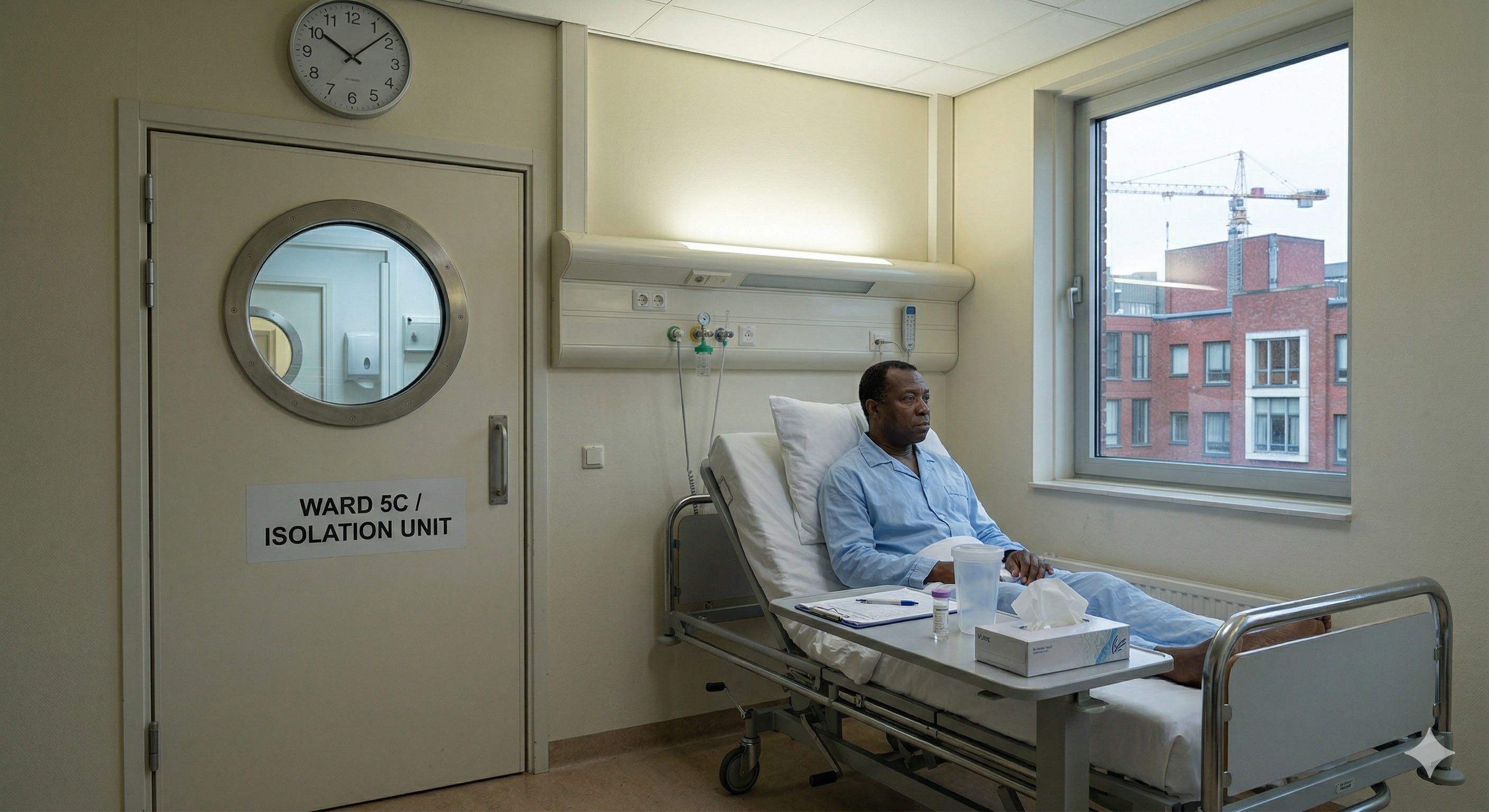
I am patient number 2288466 in isolation ward 5C. I can’t leave.
I have an infectious disease.
The airtight door has a small circular window that reminds me of the periscope of a submarine. There is a buffer zone between the door to my isolation room and the corridor. Above the door is a clock that shows how much time I have to wait before I am attended to. Time moves slowly when you stare at a clock.
I wait for the nurse to bring in my medication. I hear the air gush as the outer door is pulled open and then catch a glimpse of the nurse peeping as she puts on her N95 surgical mask and covers her hands in gloves. I wait to see who the new face will be. This is a university hospital. There is a constant rotation of nurses attending to my case. They are mostly young and self conscious, and approach me with the rehearsed script of a salesman making a routine call.
I wait to hear what language they will speak. It is often Dutch and I wait, listen to see if I can catch the words and follow the conversation. It is not what they say but what they do not say that I am interested in. I search for the unsaid by reading their body language. Is she avoiding my eyes?
That is what my sister said, when she was hospitalized with a terminal heart failure. She said there was something about the eyes of the caregivers. Watch their eyes, they rarely lie and she knew what she saw in those eyes. My sister made it out of hospital but the fatality still caught up with her. Those nurses knew something, they couldn’t voice.
I know how I felt when they admitted me into the isolation ward and I think about all those people who didn’t make it out of hospital. I know catching TB this time around is serious and this disease had stayed hidden in my body undetected for two months before it announced itself in a pool of blood that I coughed out of my worn body.
The hospital is treating the incident with caution and that is both assuring and confronting. The confronting thought is that hospitals do not always guarantee recovery. I can die and how does one behave when that is a possibility.
I can pick out a new intern straight out of college doing the rounds, asking a series of questions and when I apologize and ask if she speaks English, she appears hurried and eager to end the conversation. I think about their self consciousness, worried about how they will sound as opposed to how I really feel, I mean really feel.
I notice it is different with the older nurses, especially the integrated immigrants, who are not afraid to talk about life and not just what they can do for the patient. They sound like people who have survived and found purpose in loss. But I still wonder if they have the training and skill to discuss my mortality. What would they do if I actually told them that I thought I might die yesterday? What would they do with that information? Isolate me further, get me scheduled for a psychological test or dismiss me as a nervous wreck?
The doctor.
When is he coming? The nurse tells me to wait. She is going to ask.
I have been here for a number of days and still haven’t seen a doctor. That bothers me. The assurance of my life is in the hands of a stranger I have yet to meet.
They still need more blood to test. She doesn’t know how long it will take. Maybe a couple of hours.
A new nurse walks in. She is black and distant.
I have come to take your blood, she repeats indifferently in English when I don’t respond to the initial instruction.
I hold out my right hand, and she taps firmly, looking for a vein. The needle breaks the surface of the skin and I watch the blood rush and fill the vial. It is going to be tested, a part of me, without me and someone sitting in a lab will decide what I need to get well. I think about how life leaves a body in a room like this, one vial at a time, clinically, like the clock counting down on a microwave oven and all the medics do is really to readjust the dial, stalling but unable to stop the process.
I wait for breakfast. I don’t enjoy it because my sense of taste has not returned.
I wait for the phone calls, for the messages, the visitors and their prayers.
Should l tell everyone? Maybe not, because I have to manage their anxieties and they are not used to seeing me in this position.
Maybe I should wait for the body to heal so then we can have a real conversation about life as opposed to a caged one where I have to play strong, so that my loved ones do not panic.
I wait for the sun to shine against the window so I can feel its warmth. There is a single window with a view of the red brick towers of the hospital block. Construction work is ongoing. I can see the tip of the cranes from my window and hear the sounds of drilling. There is a spot of green, a hedge in need of love, but you have to stand at the extreme end of the room to see it.
Early in the mornings, I hear little birds tweeting and crows cawing before the rhythm thud of heavy construction machinery takes over.
The cleaner comes, nervous eyes darting above the face mask, holding the disinfectant like a revolver by his side as he heads for the bathroom.
I wait to see if he will notice that the floor needs sweeping too but his stay is brief and all I see is his back and the crumpled black plastic bag as he blurts out a mumbled Alstublieft in response to my Dank u wel and the doors seal shut behind him.
The coughing hasn’t stopped. It is violent and draining. I cannot wait for the blood in my phlegm to disappear and for normal mucus to return. I cough constantly and spit into a cup with a lid. The lab wants more of my sputum for testing.
The system now classifies me as a diseased entity, whose foreign pathogens must be monitored as they constitute a risk to public health. My mere physical presence could be a danger to others. It is different when you think about the danger you pose to your own family.
I wait for my wife to come from home with some savoury food and news of the children. She brings rice and beans in a plastic container. She sets it on the bedside table and steps back two paces, adjusting her mask and though there is a hint of a smile in her eyes, I can sense her anxiety. When she leaves, I wait for the sunset, which I cannot see from my window, and for sleep to come and sweep away my worries.
I used to read about those goodbyes and how heavy they felt for the visitor. Because you could never tell if it would be your last. All those years, I was never hospitalized. This was the first and it was serious but to tell her that I am scared would only add on to the burden of her anxieties.
I had many important things to do before that Tuesday morning that landed me in hospital. I had a dentist’s appointment, an important speaking function, a scheduled concert to attend that all joined the wait list. But it is nothing compared to coming to terms that this is moment reveals. Waiting for death that arrives at inconvenient times and disrupts our best laid out plans.
l wonder when the doctor’s confirmation that I am well will come and when I will return home to the children. I cannot fully be with them because I have to be in isolation even at home for fourteen days until I am no longer a danger to my own family. But at least we will be in the same house for their presence matters in my healing process.
This morning, I coughed and there was no blood. Just mucus, ordinary and unremarkable. I showed the nurse. She nodded. That was all. So I held the cup for a long time after she left, turning it in the direction of the morning light, because it was the first good thing my body had given me in days.
I exhaled. No wheeze. No trace of cough waiting to be expelled. Just air leaving, as ordinary as the mucus in the cup. I had forgotten what silence in the chest felt like.
You may now purchase my book Strength and Sorrow HERE.
Strength and Sorrow by Oyunga Pala is now available for purchase on Amazon for the Kindle and Paperback HERE.
Wish you a clean bill of health!