
The Last Lunch
A caterer's final meal for the dead reveals who truly belongs at a funeral.

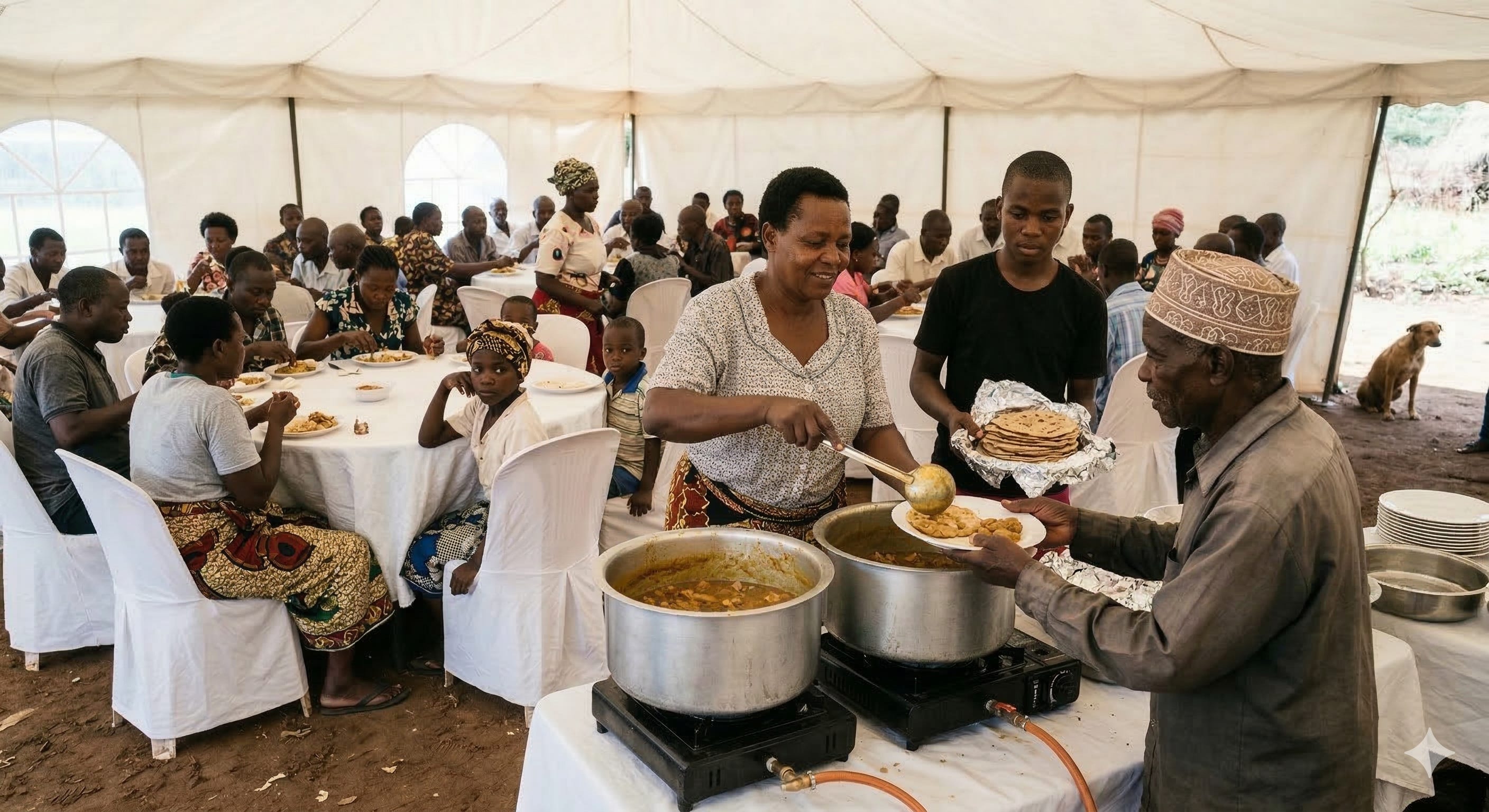
All the white tents had been set up by the time Agnes arrived.
She had left Nairobi on the morning flight to Kisumu. A taxi was waiting. Agnes would be catering to a funeral. It was the first time she was doing this. A Luo funeral no less. The daughter of the deceased, Akinyi had been a customer for years in her boutique restaurant in Nairobi West and had literally paid her airfare to have her present to serve as an exclusive caterer for the family during her mother’s last rites.
Once they got off the tarmac from the Busia highway, they were on a rough, ridged murram road lined with thick bush that led them to a walled compound. A solid beige wall that covered a compound that in her estimation was about two acres. Sitting prominently, was a modern bungalow with a sprawling verandah and around it smaller housing units. It stood out like a military garrison, in contrast to several aluminum roofed and mud walled houses that they had driven past. A lanky young man wearing baggy battle fatigue trousers at the gate pointed them to their parking spot.
It was just past 9 in the morning and the home was buzzing. There had been an overnight vigil. Akinyi spotted Agnes and welcomed her warmly and then walked her to the exclusive tent and laid out the instructions. She was to serve only the family members, once the burial was done and bring her coastal culinary flair to the village as a final honour to Akinyi’s mother.
The tent was small in comparison to two other large catering tents. It looked like it could handle under 40 people arranged around circular tables that could sit around six people. The tables were draped in white linen. Agnes began setting up her cooking station and laying out the ingredients to make the last meal. Akinyi had been adamant. She wanted something distinct from the village fare for her family. Agnes speciality of mutton curry with pilau and chapatis, that was Akinyi’s mother’s favourite, whenever she visited Nairobi. The rest of the mourners would be catered for in the general tents. This tent was reserved for the family and their inner circle, as a last honour and Agnes was assured that one of Akinyi’s relatives would take care of the people traffic. She didn’t have to worry about that.
In an hour since arrival, the home began to fill up with mourners arriving in droves. The general cooking was happening behind the main bungalow not far from her station and Agnes watched as the men slaughtered a squealing bull in the open, skinned it and then distributed the chunks of chopped bloody meat to a group of women with lesos wrapped around their waists, holding wide woven baskets covered with green banana leaves.
Agnes had two local assistants who had sourced the meat. She looked at the mutton cuts from a local supplier who reared sheep and was pleased by the quality. These were definitely grass fed and fatty in all the right places. Agnes began her prep work quietly in her cooking station, a stranger no one seemed to have noticed.
The drone of a back up generator and the loud scratchy public address system announced the start of the funeral service taking place under a huge white canopy tent in the centre of the compound. Agnes’ tent was positioned behind the main house, a slight distance from the general catering tent behind where all the cooking was conducted in the open.
Agnes stirred her two large sufurias of stew, feeling the familiar calm that came over her whenever a dish was going well. There is a midpoint in a good curry, when all the separate things stop fighting each other and merge into one thing. That moment was at hand. The fat was rendered slowly into the sauce. She bent close to the steam and inhaled. Cumin. Ginger.
When she looked up across the other tent, she was thankful that she was not catering to the masses, being ushered into the catering tent even as the funeral process was ongoing. She thought it strange to see guests arrive and be escorted to the food tent first and then directed to the ceremony tent after eating.
Her tent was still empty. She left the assistant with a pimpled shiny face and large eyes preparing the pilau and came to inspect the tent. She adjusted the centre piece on the serving table and checked her food warmers and then counted the chairs. Forty two. Akinyi had asked her to cater for about thirty but from experience forty five would be a safe bet. The spicy waft of the ingredients drifted into the tent and she was pleased by her timing. The curry would be done and settled by the time the burial was concluded and ready for the family, who, unlike the guests, had remained seated from the beginning of the proceedings and had not had anything to eat.
It was approaching midday and the home was thronged with people. There must have been hundreds, Agnes estimated. The funeral service tent was solemn, with the church clergy dressed in robes seated at the front, while the catering tent was a marketplace. There was a constant queue waiting to be served while others emerged with tooth picks sticking out of their mouths. There were children running about and dogs, at least four scrawny ones, oddly calm, just hanging around like invited guests waiting to be ushered to their seats.
The church ceremony dragged on to the mid afternoon, before the congregation stood up to escort the body to a burial site outside the walled compound. Agnes was told it was the adjacent original ancestral homestead, where the family’s departed were laid to rest. Not everyone had left for the burial site and the home now felt like a carnival. The relative, the lanky one in battle fatigues who had been directing traffic had been assigned to Agnes’ tent. He stood like a sentry, his face stern and he kept redirecting mourners who came in search of food to the general tent.
Agnes inspected her two large sufurias. The mutton curry was golden brown and creamy, ready to serve. The two assistants had spent the night rolling and cooking stacks of chapatis that were covered in foil. The burial party soon returned and Agnes recognised her guest profile. Tailored black outfits, ear pieces and eyes covered in designer sunglasses. People just kept streaming into the tent. The relative in battle fatigue trousers who previously displayed the attitude of a visa application officer at the US embassy, had become very demure and was actually shaking guests hands with both palms and his head bowed.
They arrived in layers. The immediate family first , Akinyi, her brothers moving through the tent with the particular exhaustion of people who had been performing composure. Then the Nairobi relatives catching up with phones. Then some senior individuals who carried the aura of clan elders and then a Mheshimiwa, who stuck out because he had a bodyguard walking ahead of him, holding one of his phones. Forty became sixty and the relative in battle fatigues was now hurriedly returning with more chairs to accommodate the new arrivals.
Akinyi was engaged in conversation, surrounded by guests leaning over the family members table. Agnes kept looking in her direction, hoping for a signal. At her last count, she had sixty two individuals. Her offering wouldn’t stretch that far and since Akinyi was wrapped in conversation, the party was kept waiting, until one of the Nairobi people, who had clearly not been drinking water, announced loudly,
“Kwani! There is no dishing here?” and murmuring followed.
Moments before that, a chubby woman with a patterned tall head wrap exuding authority had walked over to the cooking station without talking to Agnes as though inspecting a guard of honour and lifted the lids off the sufurias that contained the curry and even went as far as ripping the foil from the chapatis, peeling off one and eating with the calmness of a judge checking for tenderness and then just walked off without a word.
Akinyi was still engaged. Agnes couldn’t catch her eye. The assistant, the one with the oily face, kept shooting Agnes glances as more relatives hovered around the serving station. Agnes wondered. How was she going to manage the portions? Even the number of dogs had increased. Six scrawny brown dogs hovering around her cooking area. Agnes decided she would have to go ahead and instructed the assistant with an oily face to move the sufurias to the serving stations.
Everyone in the tent heard it. A dog yelping. Agnes turned to catch the horror written on the face of her assistant standing next to open sufuria, some of the curry splashed on the side as all the dogs scampered in fright. “What happened?” she demanded. His face was now glistering, his eyes wider. “Mbwa! Aki! Mbwa!” he babbled before he shared his distress. He had just turned his back to rip some cardboards that he would use to lift the sufuria, when one of the dogs dipped its mouth in the stew trying to steal away some mutton and got scalded.
All the attention was on Agnes. Akinyi demanded answers and it was the man in combat trousers who broke the news. A dog had licked the stew. Word filtered around the tent. The Mheshimiwa’s body guard verified the details from the man in combat trousers and then returned to the Mheshimiwa, whispered in his ear and he quickly got up and left unceremoniously. That triggered an exit. Agnes’ heart sank as she watched the exodus, the Nairobi people, leaving with the contained dignity of people who had decided the situation was beneath them. The combat trousers man held the tent flap open for them.
The chubby woman with a tall head dress returned, ignoring Agnes again and spoke to the man in combat trousers who had now assumed the role of a breaking news anchor. Akinyi was facing Agnes, pained, her mouth hanging half open, the words stuck, when the woman with the tall headdress came between them and just said, “What is the fuss? Return it to the fire!”
Then Agnes remembered the second sufuria and assured Akinyi that it was untampered. The tent had now filtered down to the family members and the seniors. Agnes was staring at empty chairs. Akinyi personally inspected the second sufuria with the assistant whose face was now shiny and slick and his large eyes blinking rapidly assuring her that it had been uncompromised.
Agnes picked up the ladle. She served Akinyi first. Then her brothers. Then the elders who had stayed. She moved without counting. The villagers started to arrive, for word had gotten around the compound. By the time she looked up, the tent had filled again with common villagers, sitting in the spaces that the important guests had vacated. She served a woman still wearing her leso, an old man who received his chapati like the holy communion and two children who stared at her with a directness that required no translation. The air in the tent shifted, it was delightful. Homely and noisier in a way that felt like relief.
Agnes stopped calculating, her ladle kept finding mutton. The food stretched and the family was surrounded by a gleeful audience of locals eating mutton curry and chapati with focused attention and Akinyi had leaned back on her chair for the first time, a look of contentment on her face.
The sufurias were scrapped clean. Nothing remained. The tent was empty. Just Agnes and the assistant with an oily face, whose big eyes had stopped darting around. They had begun to collect the plates left on the tables and arrange them in large sufurias for washing.
Agness sat on a chair, sipping water. She was exhausted.
The food was enough.
Akinyi approached her and pulled a chair next to her and gave her a warm hug and then placed an envelope on her lap. She held her hand for a long time and then told her,
“Mama is happy” and then left.
Agnes remained seated in the empty tent. The piles of dirty plates stacked beside her. Outside a flurry of movement continued. A scrawny dog appeared at the tent entrance, surveyed cautiously and then also left.
You may now purchase my book Strength and Sorrow HERE.
Strength and Sorrow by Oyunga Pala is now available for purchase on Amazon for the Kindle and Paperback HERE.
Brilliant. So typical. So familiar. So evocative.