
The Two Widows
Divided by suspicion, united by loss. One man’s secret, two women’s healing.

It has been three months since Bernard died, the man everyone called Baba Tasha. Grace sits alone in her spacious Kileleshwa bungalow, four bedrooms, with only her and her houseboy, Ndugu in the servants’ quarters. She lights a monthly candle to commemorate the anniversary, white, placed in front of the portrait. The mantle is a shrine now. His brown stetson and his walking cane sit there. The children have moved on. Tasha has returned to the Netherlands and Tim to the US. On the weekend, her prayer warriors group returns for another round of comfort prayers.
She picks up her Bible and note book but she cannot focus. She is listless. Everyone else moved on so easily. The children have their own lives. But not her. She won’t casually get over Baba Tasha. Not this soon.
She sits up. For three months, she’s never slept on his side of the bed, the side closest to the door. There are two matching bedside tables. She rolls over, lies where he used to lie, head against the headboard, reading. He spent his final year reading while she scrolled on her phone.
Grace realises she’s never checked what’s inside. She pulls open his drawer and finds a single book.
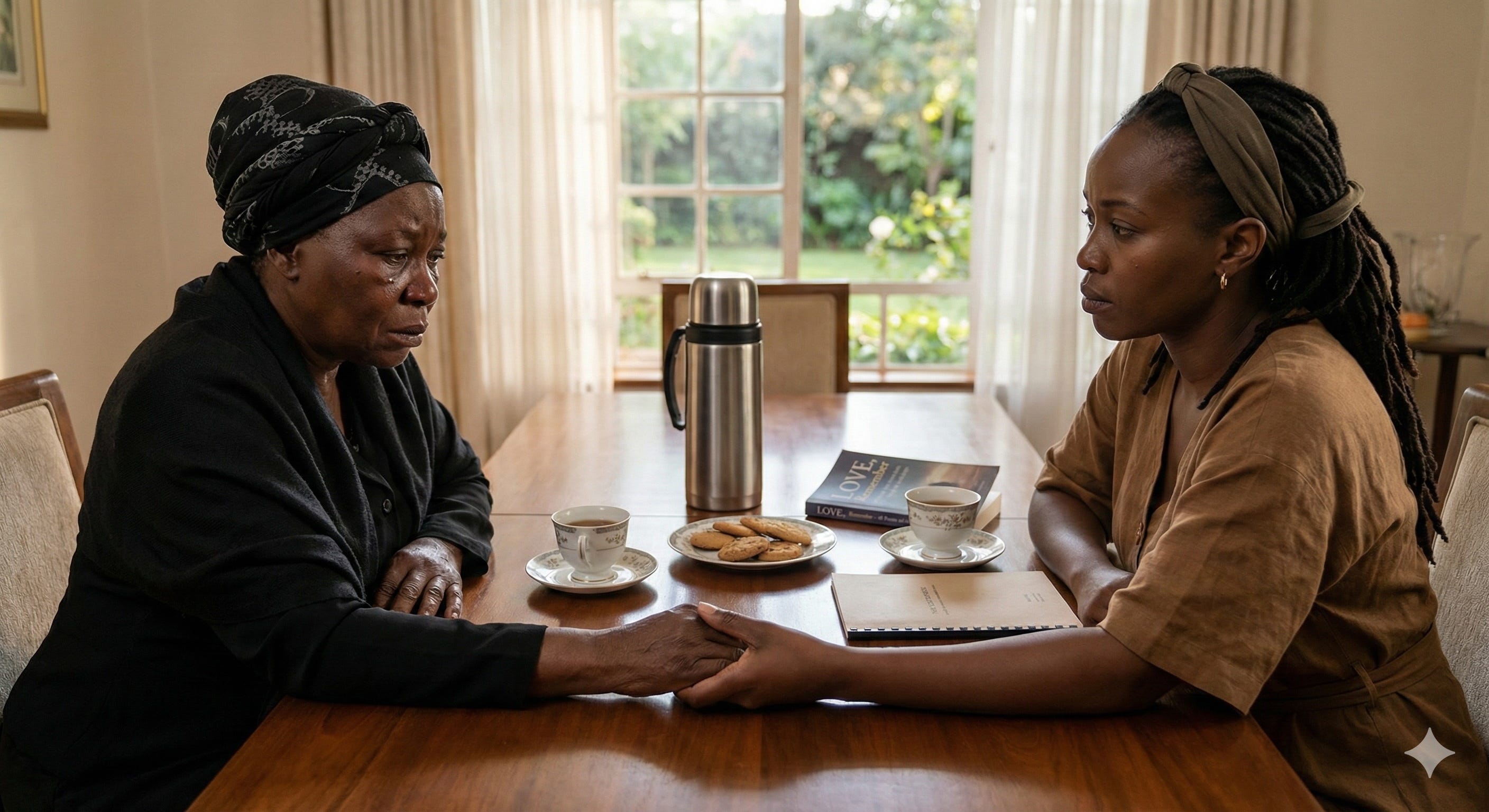
The title pricks her curiosity. LOVE, Remember - 40 Poems of Loss, Lament and Hope. Malcolm Guite. She remembers him reading it at night with a portable book light Tasha bought him. The cover contains a tiny figure beneath a massive waterfall with a rainbow in the background.
She flips it open and there is an inscription.
To my dear friend, whose words give life to mine, signed, Lendo.
Grow now, flourish, and in good time release abundance-a new crop.
Who is this Lendo? Friend? Lover? He never mentioned her. She doesn’t like where her mind goes. She closes the book, puts it back in the drawer.
It’s one o’clock and she isn’t expecting any visitors today and Grace decides to take a nap. She wakes up to a car horn at the gates. She looks out of the window to see Ndugu walking to the gate to let in an unfamiliar car. She wipes her face and reaches the living room as Ndugu enters through the kitchen entrance.
“Madam, You have a visitor who has come to say pole?”
“Who is she?”
“I don’t know, she says she used to work with baba Tasha?”
“Okay, bring her to the verandah”.
A young woman enters the verandah. Shapely, wide hips, stylish, her thick locks tied back in a band lengthening her face.
Grace observes her and notes she could be agemates with her first born Tim. She holds a wrapped package.
She greets Grace respectfully, “I’m Lendo. I worked with your husband. I am very sorry for your loss”.
Grace doesn’t hear the rest, she is busy scanning the woman’s face. Something about a magazine, a sub editor, poetry, and contributions.
In her hand was a bound booklet of his previously published and unpublished poems. “I thought you should have them”.
Grace seems unmoved and asks. “Please remind me of your name, again?”
“Lendo”.
“Okay, Lendo, can I offer you a cup of tea”. Lendo tries to excuse herself, saying she did not want to impose on her time but Grace insists.
“We are Africans, you have to at least wet your mouth” and she calls out Ndugu, who moments later appears holding a tray carrying a thermo, tea cups and a saucer of cookies. Lendo notices a subtle change in Grace’s tone of voice as the conversation turns into an interrogation,
“How long did you know my husband?”
“How did you two meet?’
“What is the name of this magazine?’
“Where are your offices?”
Lendo answers the questions politely even as the older woman’s voice grows more aggressive. Grace suddenly stands. “I want to show you something”. She leaves and returns holding a book.
“I found something with your name in it?”
She shows Lendo the inscription, “ Can you explain this? What do you mean by ‘my dear friend’? Why is a young woman like you calling a seventy year old man, ‘my dear friend’?”
Lendo is caught off guard. She remembers buying the book and dedicating it, how could she explain that this was just a source of inspiration.
Grace doesn’t bother to hide her irritation, “Did the cat grab your tongue?”
‘It’s not what you think, Mrs Okoth?”
“Oh really? The audacity of you Nairobi women. Coming to a grieving widow’s house to mock her. What kind of despicable behaviour is this?”
Lendo is quick to defend herself “No. It wasn’t like that. We were friends and we only met once in person, during a book launch. The friendship arose out of love for poetry, literature and life”.
“What were you discussing with someone old enough to be your father? Didn’t you know he was married? Have you no shame?”
Lendo starts to feel trapped, “Not at all. I was his sub editor. We talked about his work, what he was writing about and themes of his poems. He was drawn to the topics of loss, hope and love”.
Grace raises her voice, “ Did you say Love? Are you hearing yourself? How shameless are you?”
Lendo now looks visibly distressed. Coming here was a bad idea. She shouldn’t have trusted her instincts. Anything she seemed to say was getting lost in translation. But she maintained her innocence.
“There was never anything physical. Your husband was an absolute gentleman, he ….”
“Oh stop it. I might be old but I am not stupid. I know your type, yes, you are just ‘dear friends’,” Grace adds sarcastically.
Lendo realises her dignity is at stake.
“With all due respect Mrs Okoth. I never had a physical relationship with your husband”.
“Let me ask you a question, how long did you speak on the phone, be honest”.
“Well, it varies, we spoke for long stretches sometimes?”
“How long, be precise?”
“Maybe an hour and half?’
“And you expect me to believe it was all about literature. So you seduced his mind. You encouraged it, didn’t you? You wench! Were you two exchanging poems, is this the nonsense you bring to me. No wonder he never ever mentioned your name, oh! Men!” staring at the package that Lendo was still holding in her hand.
Lendo decided to change tact and speak her truth,
“If you really want to know, I will tell you. We talked about loss, lamentation and death. And you want to know why he never told you about me, well… it was because he knew you’d react just like this”.
“Who the hell do you think you are, to lecture me in my own home about my feelings, after I have been betrayed by a man I was loyally married to for 40 years. Do you know the sacrifices I made …., so why did you come, to mock his widow, why did you come here?”
Lendo realises that she is against a wall,
“Because, I loved him as a friend and I am not ashamed to say that”.
“Get out of my home, now!”
“I won’t leave,” responds Lendo, calm and grounded.
“Excuse me ! I order you to leave my house now, or I will call the askari to throw you out”, Grace declares, raising her voice and advancing on her.
Lendo remains rooted “No!”
“Who do you think you are?”
“I know what you are feeling, I understand…”
“Are you mad?”
“I know death, Mrs Okoth. I was widowed at twenty four. My husband died three months after our wedding. His family tried to poison me claiming I had bewitched their son. I was beaten, cursed, run out of our matrimonial home. It’s been eleven years since my Josh died. Not a day goes by without wishing he was here. But I survived. I stopped hating him for dying, I stopped hating myself. I learned to forgive”.
Grace responds, wounded, angry, “You don’t get to tell me how to mourn my husband.”
But Lendo maintains a calm and direct tone “I see you Mrs Okoth, I see right through this performance. You can hide behind being the hurt widow but I see you are terrified. He’s gone and you’re alone and you have to live without him”
“You think you know me?” Grace retorts.
“I don’t need to. The reason your husband called me was because I was safe. He could be afraid around me.I’d already lost everything and tasted the sting of death. He was worried about you. You were his foundation. He couldn’t let you see him weak”.
“Don’t you dare stand there and lecture me, young woman. Don’t you dare judge me. I gave this man my life, and he still couldn’t trust me with what mattered most to him… Why Bernard, Why did you do this to me?”.
Grace’s face changed from anger to deep sadness and then she burst into tears, a deep suppressed cry, finally finding release and she bent over, hands covering her face and wept.
Lendo hesitated, then moved towards the older woman and held her in a tight embrace. They both cried. Grace loudly and Lendo whimpering, “I am sorry, I am so sorry”.
Lendo held on to Grace for a long time until her body completely surrendered letting go of all the pent up tension she had been holding and when she finally looked up and faced Lendo, her face was a picture of pity and shame. She started to speak but Lendo hushed her.
“Don’t explain, it is not necessary” and Grace wept some more. In the background, Ndugu stood watching, unable to make sense of the scene. He had been drawn by the loud argument but by the time he rushed in, he found madam, whom he had not seen crying even during the funeral, completely out of character.
A thought dawned on Lendo, “I’ve been asking myself, Why did I come here? When I saw your daughter’s Linkedin post, I felt terrible about missing the funeral. I thought I was coming for closure, to pay my respects but I realise now, I think… God brought us together for a different reason.”
Grace asks, “What do you mean?”
Lendo continued “ He couldn’t help you face death while he was alive. He said he tried but you always shut him down. Somehow he found me, a widow and he felt safe enough to express his anxiety through poetry. Fate has conspired that we meet because I know death and I have walked through the valley for over a decade now.”
“I am so afraid” Grace finally confessed in a demure tone, the anger dissipated.
Lendo reassured her “That’s why he was so afraid of bringing it up. I know I’m young enough to be your daughter but this life has taught me things. There is no script, mum. But we have our prayers. And each other”
The two widows sit at the table, their hands intertwined in silence again. The thermos of tea and cookies are untouched. The book and the collection between them.
Grace rubs her bloodshot eyes and says “Thank you, for coming Lendo and for being so stubborn”
Lendo squeezes her hand and smiles.
“You are welcome, mum”.
Then Lendo opens the booklet and flips to a marked page. She reads aloud.
“We start grieving from the moment we leave the womb. Every breath after is learning to carry loss. The dead don’t leave, they just change addresses”.
Grace nods, tears still wet on her face. “Bernard wrote that?”
And Lendo just nods.
You may now purchase my book Strength and Sorrow HERE.
Strength and Sorrow by Oyunga Pala is now available for purchase on Amazon for the Kindle and Paperback HERE.
You know what... It's OK. Tears are a cleansing... And weuh! Let's just say I appreciate you for choosing to focus on grief writing because I promise it's helping me choose to live well. Muy buen!
Beautiful, just beautiful.