
Why I Wrote This Book
Writing Strength and Sorrow wasn't a choice; it was a surrender. It was the only way to heal, and in doing so, I hope to create a space for others to find strength.

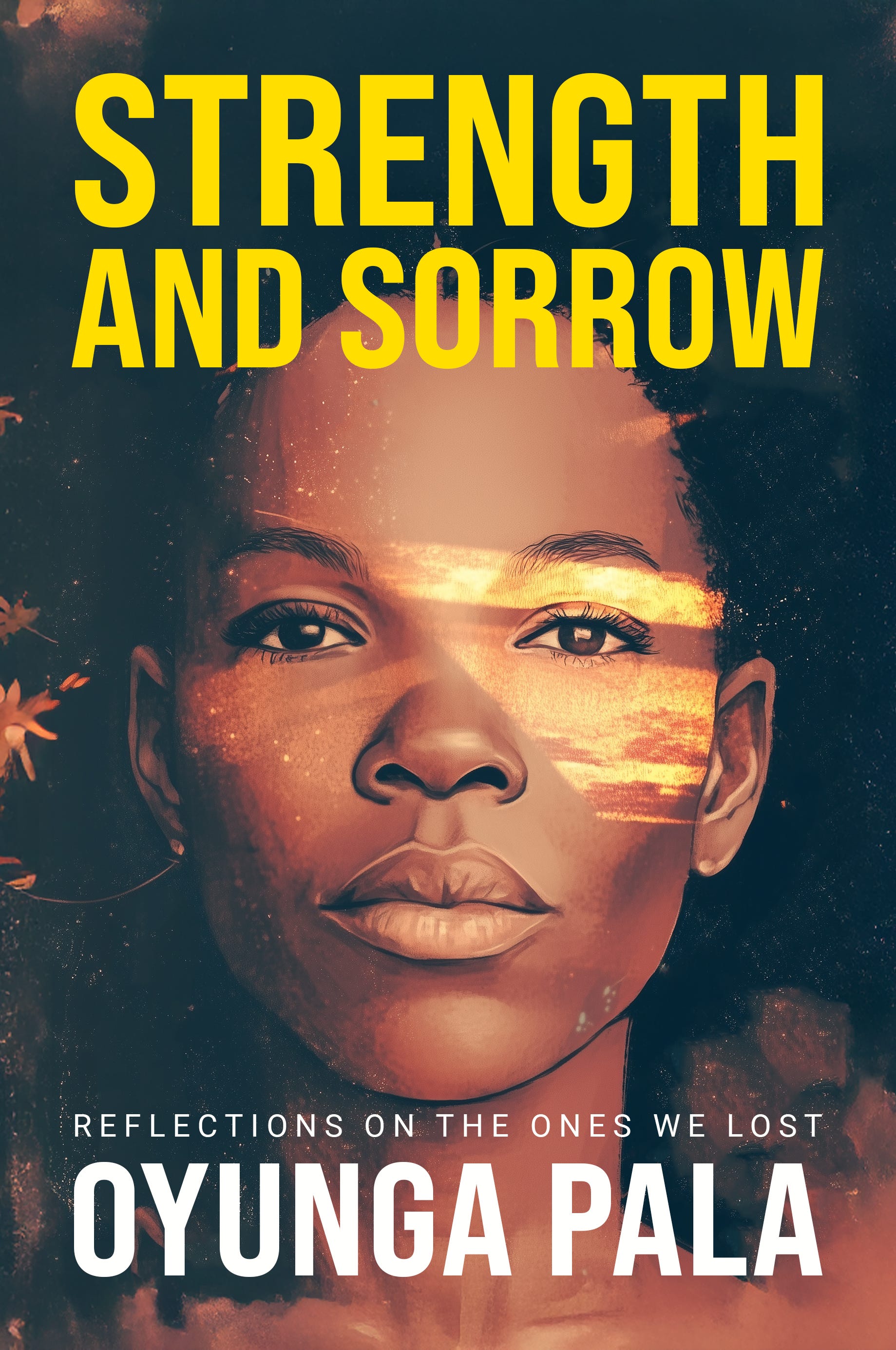
My new book is out in book shops across Kenya, yet, I haven't held a copy or touched a single page of it. My decision to print, Strength and Sorrow, in Nairobi was a deliberate choice to honor the people who helped me find my voice and as a gesture of gratitude, to place their access to my words before my own. As I wait for my copy to cross the world to my base in the Netherlands, I've reflected on why I wrote this book. The answer lies not in a single event, but in a lifetime of quiet preparation, and a deep-seated belief that writing, above all else, is a service to the public you serve. It has been a journey of 28 years to this point.
I learnt the art of public service from my father. My father was in my view fully realised as a man. He was a man who talked about the future and its possibilities and rarely did you hear him complain. When you come from a large family, different siblings will hold different versions of the man they call father. My three elder brothers talk of a harsh ‘fathe’. A man of few words who did not tolerate crap or sloppiness.
The difference between my eldest sibling and I was 13 years. By the time I was born, I guess fatherhood had mellowed the mzee and I had the privilege of a father who kept me in close company. I was a boy in training, an escort on his daily rounds. I would sit in the car while he talked with his friends, learning to spend a lot of time quietly and observing people willing time away. I realize now that this training was a preparation for a different life, one that would be defined by the quiet art of listening.
By age 12, I had learnt how to handle an oxen plough. It was quite an achievement
for a city boy. To wake up at dawn and troop to the shamba to plough.
My father never made me feel special. Work was simply work and everyone had to put in their fair share. I still enjoy farmwork but mostly because of the discipline it cultivates.
When my father suddenly died in 1989, it left me adrift. He was my guiding star. Death was one thing that I had never factored in the equation. It was at his funeral that I really came to appreciate what kind of man my father was from people who showed up to pay their last respects. It was all a daze. People and more people sharing the impact he had on their lives. Where did he get the time to help all these people and raise 6 children? He never talked about it.
After the passing of my father, in my mid teens, I got fascinated by the mysteries of life, in my grappling with the phenomenon of death. I had read the Bible regularly as a story, much like a novel but I soon began to ask questions about the historical foundations of the text. I often wondered how a holy book that had entered into our cultural space a mere 100 years ago had obliterated indigenous African spirituality.
Still confused by the nature of death, I found myself questioning life's purpose. One day as I was walking down a main street in Eldoret town, I noticed a pharmacy run by Asians and decided to just try my luck. I ventured into the pharmacy and asked the lady at the counter where I could locate any literature on their belief system. She handed me a magazine, titled Osho Times and I devoured the copy that same day. It was a door to a new world of esoteric mysteries. The philosophy that a person could master their suffering and forge a meaningful life was a truth I had been seeking.
My early love for reading led me to my father’s small library, a bookshelf in our village sitting room that held a few gems. In it was Peter Abrahams “Mine Boy”, Charles Dickens “A Tale of Two Cities”, Aldous Huxley, “Doors of Perception”, Philip Ochieng “The Kenyatta’s Succession” and Ngugi wa Thiong'o’s “Detained: A Writer's Prison Diary planted the seed for a mental decolonization.
I would never have fathomed how influential those books would become. But what I truly enjoyed reading were newspaper columns, which became my favourite sections in newspapers and magazines. I was fascinated with how serious topics could be delivered with humour and insight.
Columnists have been a long standing favourite of my newspaper reading. Hilary Ngweno’s editorials in The Weekly Review were a masterclass in political analysis. I admired Philip Ochieng’s fidelity to language long before I could fully grasp the depth of his columns.
I regularly read Kwendo Opanga and Mutahi Ngunyi who covered all the political power plays. The celebrated Wahome Mutahi’s satire would catch on later and I started to feel smart when I developed the ability to read between the lines in his columns.
The story of how I became a columnist is a series of happy accidents. I never wrote much outside of my academic assignments until one day a colleague asked me to submit a piece for the AIESEC group in university that published a newsletter. A few encouraging compliments would eventually set me off on my journey as a man of letters. To augment my survival at the University of Nairobi where I was on a bursary, I joined Nautilus gym as a fitness instructor. It was in this gym on Mombasa road in Nairobi that the true beginning came after a conversation with Billow Kerrow, who would become a prominent politician.
He liked my perspectives and challenged me to write about fitness, and with a name and a vague address, I set off for the Nation newspaper office. My contact wasn't there, but while wandering around the building, I found Mundia Muchiri, the editor of a new pull-out Saturday magazine. He took a chance on my typed pieces, and a month later, my name was in the country's biggest paper. It was a small section that I shared with a Reddy Kilowatt advert. My word count was under 350 but I was now getting paid for my words.
I graduated to writing feature stories for the Saturday magazine when Mundia left to start the Eve magazine and Joy Mutero took over as editor. I always maintained a regular fitness column. The editor who really put me on the map was Rhoda Orengo. I had arrived to submit one of my regular fitness columns in the pre-email days when she challenged me to write something for the Mantalk column. I had an active college life and shenanigans were plenty. I picked up an incident and wrote about it. It got published and I was encouraged to write more. The column was held by three writers, Cylde Morvit (Allan Kopar RIP), Tony Mochama aka Smitta who would mature into a unique and prolific voice with an enviable stack of books to his name.
By about 2000, I had inherited the column and my journey commenced. I thought I could write but I knew nothing about the craft. I was squeezing writing into my day, constantly chasing deadlines. I could never make proper time for writing and did not treat it with the respect it deserved. I had bought into the narrative that you cannot really make a living as a writer and precious writing time was lost in pursuit of side gigs. But, I finally got it. It was a discipline. Writers write all the time because that is the only way you can truly grow.
One subject that I kept returning to in my columns was the subject of death, even then, I thought I was only writing public obituaries. My attraction to obituaries was more generational work. It was the death of Wahome Mutahi that triggered it. His Whispers column was the epitome of column writing. The gold standard. I wanted to write for the public memory but I wrote as a detached, objective observer. I was documenting the lives of others, celebrating them, honoring them and learning from their journeys. But this public act was a shield. The more I wrote about others, the more I was drawn to my unresolved grief and the memories of those I had lost. My public mission to remember others was in essence a private mission to suppress my own pain.
I grew up in a society that avoids discussing death, treating it as something to be endured, not understood. This cultural conditioning taught me to internalize my pain. Death was a "terror monster," and my initial response to loss was to "suppress and carry on."
It wasn’t until a motorcycle accident that would happen the same year that I hung up my spurs after 11 years of writing The ManTalk column that I arrived at a critical turning point. It shattered my detached observer role and forced me to confront my own mortality. I could no longer pretend to be a passive writer; I was now a participant, a person who had felt the stealthy approach of sudden death. This moment compelled me to look inward and use my writing not as an escape from my grief, but as a way to engage with it directly.
I had found a tool I could use to reflect on the losses in my own family, alongside stories from my countrymen that I had collected over the years. In listening to their experiences, I realized that my story was not unique. I felt deeply connected to people I've never met, and I could empathise with their sorrow. The act of gathering their stories became an act of self-discovery, allowing me to find the courage to relive and process my own forgotten grief.
This book is essentially a communal act of mourning, a collective ritual of remembrance. I return to my Kenyan public in humble service, after years of introspection. Writing about death and loss was not a choice; it was an inevitability. It was the only way for me to heal, and in doing so,I hope to create a space for others to find the strength to confront their own suppressed sorrows borne from loss. This book is not about giving answers, but about inviting my readers into a long overdue conversation, a public acknowledgment of our shared humanity in the face of death.
Strength & Sorrow has landed in Nairobi! You can now grab your copy at 5 bookstores across the city.
- Text Book Centre
- Yaya Bookstop
- Nuria Book Store
- Half Priced Books
-Prestige Book Shop
Or simply place an order on my website
https://oyungapala.com/
I hope you gain something of value from this read. Asante.
The dirges during funerals in Western Kenya are meant to be celebratory- the joy of having met and experienced life with someone whose physical body is probably being kept in the same compound awaiting a set burial date. It is a time for the local villagers to get drunk and have a reason to spend the night outside around a bonfire, listening to the local DJ playing a casette tape that has been heard over and over again from his squelching meter-tall dusty speakers. It is also a time for the bereaved family to look for a cow (if the departed is a lady) or a bull (bless the departed man) that is going to feed the masses for as many a days as they would like to keep the actual burial ceremony pending.
I experienced these rites first-hand. In a span of one year, four close family members transitioned into the afterlife. Their voices now exist only in the memories of us who had to bury them. And in the videos that mobile phones were able to capture. Their names do not pop up anymore whenever the phone rings and certainly no need to call their numbers because the mobile service provider has possibly deactivated and blocked the numbers. But that is just again also half-truths because what if I call the number and someone else answers? I can’t bring myself to that. (PS: I did and I was totally heartbroken that it has been allocated to someone else)
Many stories end in death. However, I think that death was just but the beginning of mine. I was coincidentally 40 when all these happened. You know the saying about life beginning at a certain age, don’t you?
I learnt that people mourn differently. Even though we all shared a parent, my father was not necessarily my brother’s or sister’s father. Being the last-born in the family, the circumstances of mom mothering me were different from that of my eldest sister. She was older. She had retired. Dad had taken up full-time farming in place of a blue-collar job with the railways company. My siblings had his presence during his time in his 30s and 40s. He parented me in his late 50s till his death in his 80s.
Thus some of my siblings withdrew into their shells. Some became very vocal and easily sparked by the most trivial of issues. I burnt out from work. But I needed to be a phoenix to rise from those ashes and make the best of the circumstances. The therapist said something interesting that I knew all along, but probably needed someone to articulate it for it to take effect: Life moves on.
Inasmuch as I was consumed in my world of mourning, the local Dekamarkt supermarket still opened faithfully at 7:30am and closed at 8pm just as it was published on their website and on their main entrance. Internally though I was furious as to how the neighbour could still be going grocery shopping on Saturday afternoons just as he had done before. Didn’t he know that I am mourning? Couldn’t he see that I was enduring such heartache? But I also realised that they are not in my world, have never been and they never will be. My son’s school teacher still expected him to show up to school. On time. Every day. I had to wipe my tears and stand up and keep up. A community of friends helps. Living in a foreign land is hard enough on its own.
A common theme that I encountered was the encouragement to take a break. “Sign out of everything,” they said. “Go to Dubai for 2 weeks and then to Thailand for another two.” You see, not everyone has that luxury. Some are raising young children, while some are applying for jobs. We have a mortgage to pay and home renovations and repairs that are pending. I cannot leave for Chile for an ayahuasca-filled encounter in the desert. With whom do I leave my one year old son? Who is going to pack lunch for his elder brother?
I found solace in construction creativity. I am almost done with the renovation of my parents’ house and I tried to replicate European standards with the renovation. 100% match it is not, but I can say a close 95% it is. I saw how local fundis are able to produce quite impressive results with the right guidance and checking-ins, thanks to WhatsApp. I still listen to local Kenyan radio. Sundowner on KBC English service. Keeps warm the memories of those that have departed.
You didn't do a stint with a magazine called Adam?